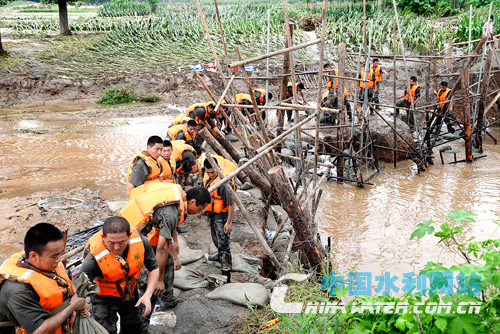
The officers and men of the "Tiger Division Tiequan Regiment" fought continuously to block the breach.
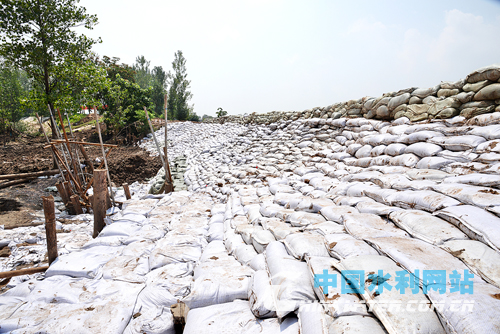
The breach of Chongyang River Chongyi section after the completion of blocking and restoration
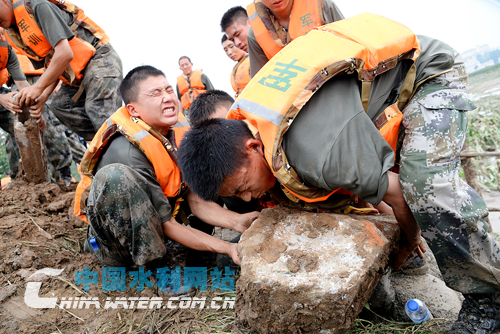
Strive for emergency rescue
□ Our reporter Li Lele Dong Yiming/Wen Yang shaping/photo
In 2016, during the main flood season, a torrential rain raided the northern part of Henan.
The rainstorm lasted from 8: 00 on July 18th to 8: 00 on the 21st. The rainstorm centers were located in Linzhou City, Anyang County and Xinxiang City in Anyang, Henan Province. Overguaranteed flood occurred in Anyang River, and the flood storage and detention area of Cuijiaqiao naturally flooded, and Xiaonanhai, Zhangwu and Shuangquanshui reservoirs all exceeded the highest water level in history.
The 24-hour maximum rainfall is 728 mm at Baishiwan Rainfall Station, 697 mm at Donggang Rainfall Station and 662.5 mm at Yanhuashui Rainfall Station in Linzhou City, Anyang, with rainfall frequency of 1,000 years. The rainfall station at Xindayan, Anyang County, Anyang City is 549 mm, and the rainfall station at Wujiajing, Linzhou City is 534.5 mm, with rainfall frequency of 300 years.
According to the data, the annual precipitation in Anyang is about 617 mm, and this torrential rain is equivalent to more than one year’s rainfall in the local area.
Nowadays, floods and waterlogging caused by rainfall in Anyang have receded, and people’s production and life have returned to normal. We should look back at the defense process of this flood, sum up our experience and prepare for the next round of storm and flood test.
The duration is short, the intensity is high, the area is concentrated, and the rain and flood are extraordinary.
Affected by the eastward movement of low trough, low vortex and shear line, from 8: 00 on July 18th to 8: 00 on July 21st, the average rainfall in Anyang, Hebi, Xinxiang and Xinyang was 231 mm, 213 mm, 119.6 mm and 101.4 mm respectively. Among them, the maximum rainfall in one hour is 117.5 mm at Xindayan Rainfall Station in Anyang County, and the maximum rainfall in six hours is 430.5 mm at Baishiwan Rainfall Station in Linzhou City.
According to statistical analysis, there are 152 stations in Anyang with accumulated rainfall exceeding 100 mm; Among them, there are 43 stations over 300mm, covering an area of 2,162 square kilometers; There are 7 stations over 500 mm, covering an area of 885 square kilometers.
With the torrential rain pouring down, the torrent and turbid waves are rolling in, and the rivers and lakes in northern Henan Province have been experiencing a continuous water level rise since the afternoon of the 19th. Among them, the Xiaonanhai large reservoir of Anyang River in Anyang City has a maximum reservoir water level of 175.65 meters at 2 o’clock on the 20th, a flood limit water level of 15.65 meters and a historical maximum water level of 0.23 meters. At 19: 00 on the 19th, the Zhangwu medium-sized reservoir in Anyang River had a maximum reservoir water level of 129.46 meters, a flood limit water level of 2.46 meters and a historical maximum water level of 0.96 meters. At 20: 00 on the 19th, the medium-sized reservoir of Pink River in Anyang City had a maximum reservoir water level of 221.80m, a flood limit water level of 7.80m, a historical maximum water level of 2.31m and a design water level of 0.35m..
For a time, the three reservoirs were in an emergency at the same time and flooded.
Affected by flood discharge and rainstorm, the flood peak water level of Anyang Hydrological Station of Anyang River was 75.66 meters at 23: 30 on the 19th, exceeding the guaranteed water level by 0.48 meters, and the flood peak flow was 1,730 cubic meters per second, exceeding the guaranteed flow by 550 cubic meters per second. There are three breaches in Anyang River and one breach in Shimen River in Weihui City, Xinxiang City.
According to the plan, when the flow of Anyang River reaches 300 cubic meters per second, the flood storage and detention area of Cuijiaqiao in the lower reaches of Anyang River naturally enters the flood, and at 22: 25 on the 19th, the flood reaches Cuijiaqiao.
The torrential rain caused serious waterlogging in the urban area of Anyang City, and a large amount of water accumulated in the surrounding farmland. Traffic, electricity and communication in some towns and villages of Linzhou City, Anyang County and huixian city, Xinxiang were interrupted, and the Anyang section of Beijing-Guangzhou Railway once ran at a speed limit. The affected population is 1,552,000, and the affected area of crops is 1,127,800 hectares.
In the face of flood, at 18: 00 on the 19th, the Henan Flood Control and Drought Relief Headquarters launched the flood control level III emergency response, and the Anyang City Defense Index launched the flood control level I emergency response at 17: 00 on the 19th. Xinxiang, Hebi, Jiaozuo and other cities also launched the flood control level II or III emergency response respectively.
For a time, the northern part of Henan was worried, and the central plains was worried.
The provincial party Committee and government attached great importance to it and made decisive decisions, and the whole province made careful arrangements to deal with the flood.
The flood disaster affects the hearts of the Supreme Leader General Secretary, as well as the people of the whole province and the leading bodies of the Henan Provincial Party Committee and the provincial government. The General Secretary of the Supreme Leader mentioned the rain situation in Henan many times, and the National Defense General sent a working group to Anyang disaster area to guide disaster relief. Xie Fuzhan, secretary of Henan Provincial Party Committee, and Chen Runer, governor of Henan Province, have made many important instructions and instructions on flood control, emergency rescue and disaster relief.
Late at night on July 20th, Chen Runer, Governor of Henan Province, made a surprise visit to the Henan Flood Control and Drought Relief Command Center to preside over an emergency meeting of the provincial defense index. He demanded that the spirit of the important speech of the Supreme Leader General Secretary on doing a good job in flood control, flood fighting and disaster relief work should be conscientiously implemented, leadership responsibilities should be further tightened, various measures should be implemented, and all flood control and disaster relief work should be done unremittingly to ensure the safety of people’s lives and property.
On July 21, the Henan Provincial Party Committee and the provincial government held a video conference on flood control and flood fighting in the whole province. Xie Fuzhan, secretary of the Henan Provincial Party Committee, and Chen Runer, governor, made arrangements for the next flood control, flood fighting and disaster relief work. Wang Tie, Vice Governor of Henan Province, presided over the Chamber of Commerce of the Flood Control Association to judge the flood control situation and make arrangements.
On the night after the flood, Wang Tie, vice governor of Henan Province, and Li Liushen, director of the Water Resources Department of Henan Province braved the rainstorm and went to Anyang City to guide the flood control and disaster relief work at the first time. Henan Flood Control and Drought Relief Headquarters sent two working groups to the front line for inspection and guidance. Henan Provincial Defense Office has issued many notices and organized meetings, and put forward specific measures for reservoir dispatching, flood detention area utilization, emergency rescue and disaster relief. At the same time, the Henan Provincial Defense Office urgently dispatched 475 pieces of lead wire mesh, 20 rubber boats, 2,000 life jackets and 200 lifebuoys to support the emergency handling of the South-to-North Water Diversion Project and the emergency rescue and disaster relief work in Anyang City.
Anyang City mobilized planes to airdrop daily necessities to seven villages trapped in Duli Town, Anyang County, thus solving the living difficulties of 2,600 people.
The party committees and governments of the affected counties and cities attached great importance to the process of heavy rainfall, actively organized the response, led the leaders to go deep into the front line to command, and the responsible persons at all levels stuck to their posts and earnestly performed their duties, winning the initiative in responding to the rainstorm and flood.
Scientific and precise operation, 90% peak cutting of two reservoirs
On July 25th, the reporter went to Xiaonanhai Reservoir in Anyang City. After the thrilling rainstorm, it became calm. The Anyang River in the northern part of Anyang City experienced the impact of torrential rain and flood, but An Lan was unharmed. What many people don’t know is that for the safety of Anyang City, policy makers have gone through treading on thin ice for several hours before.
After the torrential rain hit Anyang, the rain area was mainly concentrated in the western mountainous area, and the flash floods quickly gathered and rushed downstream. Anyang River is a flood channel in Anyang City. The maximum overflow capacity of the old Anyang Bridge is only 1 180 cubic meters per second, and the flow after the superposition of floods in mountainous areas is several times this. If flash floods flood into Anyang City, the consequences will be unimaginable.
At the critical moment, Xiaonanhai Reservoir, Zhangwu Reservoir and Shuangquan Reservoir in the western mountainous area of Anyang City played an important role, and accumulated 200 million cubic meters of flood water in the reservoirs. "When the water rose fastest, the water level of Xiaonanhai Reservoir rose by two meters in one hour." Li Chaoyang, chief engineer of Zhangwu Nanhai Reservoir Management Bureau, recalled.
With the continuous influx of floods, the capacity of reservoirs to accommodate floods has reached its limit. The three reservoirs are like three basins of water on the head of Anyang City. The elevation difference between Xiaonanhai Reservoir in the upstream and Anyang City is about 100 meters. If serious accidents such as dam break occur, the consequences will be very serious. Among them, Shuangquanshui Reservoir is a natural overflow reservoir, and there is no gate to control the discharge. At about 20 o’clock on the 19th, the rising water level rushed down through the spillway, and the maximum discharge reached 1 500 cubic meters per second.
The Shuangquan Reservoir is located on the Pink River, a tributary of Anyang River, and it can be said that it cannot be dispatched because there is no control project. Under the condition of heavy rainfall, the maximum inflow of Shuangquan Reservoir is 1 970 cubic meters per second, and the maximum inflow of Zhangwu and Xiaonanhai Reservoir reaches 3 000 cubic meters per second, which brings great pressure to the flood control of Anyang River downstream. The Provincial Defense Office decisively dispatched Xiaonanhai and Zhangwu Reservoirs on the main stream of Anyang River to avoid the overlapping of flood peaks of Anyang River and Pink River, and realized peak clipping and peak shifting.
From 22: 40 to 24: 00 on the 19th, the discharge of the two reservoirs was reduced to 250 cubic meters per second, and the flood peak was reduced by 92%, making way for the double spring reservoir to discharge the wrong peak, avoiding the overlapping of flood peaks and ensuring the safety of the urban area.
"It is necessary to ensure the safety of the downstream and the safety of the reservoir. The scheduling is extremely difficult and very thrilling. We just want the wrong peak and successfully avoid the superposition of flood peaks. " Recalling the dispatching process, Shen Jiwei, director of the Provincial Defense Office, said.
Through scientific dispatching and precise response, Henan Province won the initiative in the face of floods.
On July 21st, Xiaonanhai and Zhangwu Reservoirs were jointly dispatched to reduce the discharge to 100 cubic meters per second, which created favorable conditions for plugging the three breaches of Anyang River. Through real-time consultation and scientific joint adjustment, the flood was effectively stopped, the flood disaster in Anyang city was alleviated, and the safety of downstream railways and expressways was ensured.
However, the flood storage and detention area of Cuijiaqiao, which naturally enters the flood, has a flood storage and detention capacity of 43.68 million cubic meters, which avoids the greater losses caused by the flood. According to the operation plan of flood storage and detention areas, the Henan Flood Control and Drought Relief Headquarters issued a dispatching order in advance, demanding that all preparations for the operation of flood storage and detention areas be fully made. The local government moved and resettled 43,586 people in advance, and concentrated on resettling more than 7,800 people. The Cuijiaqiao flood storage and detention area achieved zero casualties.
Over the years, Henan Province has persistently carried out large-scale water conservancy construction. By the end of the flood season in 2016, 2,653 reservoirs had been built, including 25 large and 121 medium-sized reservoirs, 19,500 kilometers of levees above grade 5, 14 flood storage and detention areas, and 365 large and medium-sized sluices. The flood control, drought relief and disaster reduction engineering system has been initially established, which is the "hardware" support for flood control and decision-making.
In recent years, the flood control video consultation system built in Henan Province has been linked to the National Defense General and connected to the flood control and drought relief headquarters of 18 provincial cities, 135 counties (cities, districts) and more than 700 township governments, which has basically realized the interconnection of provinces, cities, counties and key towns and villages, and played an extremely important role in this flood response, which is the "software" support for flood control dispatching and decision-making.
Hydrological "sharp soldiers" rushed forward, and "staff officers" and "assistants" United and cooperated
On July 19th, the consultation room of Henan Flood Control and Drought Relief Command Center was brightly lit, and experts from Henan Provincial Defense Office, Henan Provincial Hydrology and Water Resources Bureau stayed up all night, always keeping an eye on the big screen of water and rain, until the flood receded, and everyone took turns to catch up for two hours.
On May 18th, Henan Province entered the flood season in an all-round way. Flood control, meteorology, hydrology and other departments at all levels in Henan Province adhere to the 24-hour duty system for flood control, closely monitor the development of water conditions and flood, strengthen analysis and judgment, encrypt the frequency of consultation, and make rolling flood forecasts to ensure the safety of people’s lives and property to the greatest extent.
Cross the sea to show the true colors of heroes. In the face of the flood season, Henan hydrologists, as the leading soldiers on the water conservancy front and "staff officers" and "assistants" in flood control, rushed to the forefront of flood control without hesitation.
On the evening of 19th, the hydrological center of Henan Hydrology and Water Resources Bureau was brightly lit all night, and the leaders of the bureau and all the staff of the hydrological department stayed up all night to study the flood situation, review the reported data and release the forecast. At the same time, the province’s hydrological emergency monitoring plan was launched, and cross-regional linkage was carried out on a large scale. Six temporary hydrological emergency monitoring commandos overcame the difficulties of high-speed closure, road erosion and traffic obstruction, braved the storm in the dark, and even risked their lives. They rushed to the front line of Anyang hydrological forecasting and immediately put themselves into the intense flood prevention and forecasting work.
They used the advanced hydrological emergency monitoring command vehicle to fill the blind spot of flood control information caused by the interruption of public communication, and uploaded the scene of the flood gate of Anyang River and Cuijiaqiao flood storage and detention area to the provincial defense office command center at the first time, which provided valuable information for dispatching decision.
In the process of resisting heavy rainfall and flood disasters, many "sharp weapons" have unblocked information transmission, making it more efficient to subdue the flood.
Since 2010, the prevention and control project of mountain torrents has completed an investment of 1 billion yuan, built a mountain torrents disaster monitoring and early warning platform at the provincial, city and county levels, 12,977 simple rainfall monitoring stations and 5,022 simple water level monitoring stations, and formed a mountain torrents disaster monitoring and early warning system at the provincial, city and county levels. In this "big test" of mountain torrents, 35 counties in the province used the monitoring and early warning platform of mountain torrents to issue 90,219 early warning messages to 251 townships and 3,612 villages, effectively avoiding casualties.
At the emergency meeting of Henan Flood Control and Drought Relief Headquarters on the evening of July 20th, Chen Runer, governor of Henan Province and commander of the provincial flood control and drought relief headquarters, pointed out in particular that this round of precipitation has a wide range, great intensity, heavy disasters and great losses, but the weather forecast is accurate, the hydrological dispatching is scientific, the organization is strong, and the disaster losses have been effectively controlled, which should be fully affirmed.
The "division of steel" continues to fight, and the current flood is the mainstay.
Where there is danger, there are soldiers. Officers and men of the People’s Liberation Army and the Armed Police Force, the "division of steel", have once again become the mainstay to resist floods.
The Tiger Division of the 54th Army sent more than 3,000 officers and men to participate in flood fighting and rescue, and fought for 4 days and nights continuously, successfully completing the task of blocking the breach of the Anyang River and re-embankment, making outstanding contributions to local flood fighting and rescue. Various detachments of Henan Armed Police Corps have sent more than 5,000 troops to support emergency rescue and disaster relief in disaster-stricken areas.
Danger is an order. After the flood, the "Tiger Division Iron Boxing Regiment" heard the order and fought day and night to deal with the danger again and again.
At 13: 00 on July 20, a breach occurred in the dam of Chongyang River Chongyi section. The "Tiger Division Tiequan Regiment" dispatched 230 officers and men to quickly go to the front line of flood control. "Rescue is fighting, and we can’t keep the levee and become the people’s soldiers." Political commissar Xie Tianping’s brief and powerful mobilization greatly boosted morale.
After arriving at the scene, they decided to adopt the tactics of shift work. Rescue officers and soldiers loaded the soil, carried it, carried it by hand, and fought continuously.
At 19 o’clock on July 20, the "Tiger Division Tiequan Regiment" received another order, and the dam in Lvcun section of Anyang River was in danger of breaking, which seriously threatened people’s lives and property. The regiment immediately dispatched more than 200 officers and men to rush to the battlefield and once again launched a life-and-death battle to block the breach. They carried wooden stakes and steel pipes with their shoulders, inserted them into the deep soil, tied them firmly with iron wires, and then filled in sandbags one by one.
At night, the officers and men of the army and the militia lit the night lights, packed sandbags, moved stones and stuffing, licked their lips when they were thirsty, and sat in the mud for a few minutes when they were tired, all racing against time.
When the breach succeeded in closing the dragon, people’s cheers rose higher and higher, and many people shed tears of excitement.
At present, the whole province is still in the main flood season of "Seven Downs and Eight Ups", the meteorological situation is complex, the possibility of extreme weather and heavy rainfall is still very high, and the flood control task is extremely heavy. This requires the whole province to prevent paralysis and fluky psychology, and must not be careless and slack. Henan water conservancy people will also be eager to face the new test and go all out to protect the flood.
Source: china water resources news, August 5, 2016




 Respondents’ cognition of canned food
 Respondents’ purchase of canned food