Original title: The horn of Beiping liberation blows from here.
Military encirclement, political struggle and peaceful liberation of Peiping have become a shining example in the history of China’s people’s liberation war, which is known as the "Peiping way".
As an important witness of this period of history, Wuliqiao Village, a little-known village with less than 100 households, has been recorded in history. The three peace talks from the end of 1948 to the beginning of 1949 sounded the horn of the peaceful liberation of Peiping, and the last Wuliqiao peace talks completely opened the door to the peaceful liberation of Peiping. Today, the negotiation monument of Wuliqiao for the peaceful liberation of Peiping, which is erected in Wuliqiao Park on the east side of Donggao Road in Changying Township, is still telling future generations about the military strategy and great achievements of the revolutionary ancestors in the war years.
Overture to peace talks:
Military pressure and political struggle go both ways.
As early as sketching out the strategic concept of the Battle of Peiping and Tianjin, the Communist Party of China (CPC) took fighting for Fu Zuoyi’s uprising as an important task, and divided it into several lines to do Fu’s work.
Prior to this, communist party had left a "pawn" beside Fu Zuoyi. One day in 1946, Wang Yu, alias Zhang Zhigong, was appointed by the CPC Central Committee and found Yan Youwen, an underground member of the CPC who had lost contact with the party organization for seven years.
At this time, Yan Youwen’s position and position in Fu Zuoyi’s army is already very high. Besides being the secretary of Fu Zuoyi, he also serves as the director of the 12th War Zone Chief Department, the deputy director of the Political Department and the president of Struggle Daily, the organ newspaper of Fu Department.
Yan Youwen, in accordance with the instructions of the CPC Central Committee, exerted a subtle political influence on Fu Zuoyi without being exposed for small local battlefield information.
In the second half of 1948, the war of liberation entered a strategic decisive battle. The Central Committee of the Communist Party of China thinks that the time is ripe, and under the preparation of armed struggle, he actively strives for political victory for Fu Zuoyi.
On a Sunday morning in early October, 1948, the leader of the Academic Committee of the South Department of Tianjin sent someone to Qianmen East Station to stop Fu Dongju, an underground member of the Communist Party of China, who was about to get on the train and return to Tianjin, and let her work in Tianjin Ta Kung Pao return to her father.
After returning to Peiping, Fu Dongju was surprised to find that his father was reading Chairman Mao’s works and sketched out the key points with red and blue pens, so he often secretly put the progressive magazines and books in the liberated areas on his father’s desk. Fu Zuoyi sometimes looks through it.
Fu Zuoyi has many misgivings. After years of war, can communist party really accept him? If the peace talks are successful, how will the subordinates who have been risking their lives for many years be placed? Fu Dongju reported to the underground party organization one by one, and then came back to persuade Fu Zuoyi carefully according to the instructions of the party organization to dispel his doubts.
At the same time, the underground party Committee also used Li Bingquan, secretary of the vocational youth branch of the CPC Pingjin Committee. Li Bingquan used to be the director of the interview department of Pingming Daily, the organ newspaper of the Kuomintang’s "General Suppression" in North China, and his cousin Li Tengjiu was the major director of the liaison office of the "General Suppression" in North China in Fu Zuoyi. Li Tengjiu was pessimistic about the current situation. Under Li Bingquan’s persuasion, his doubts and precautions were completely eliminated and he promised to work in Fu Zuoyi.
Cui Yueli, the academic committee of the underground party, also worked with Fu Zuoyi through his teacher Liu Hou in Fu Zuoyi.
At the end of November, the Northeast Field Army was constantly stationed around Beiping, and Fu Zuoyi was on pins and needles in his office, and his thoughts and emotions were in extreme contradiction.
Fu Zuoyi’s daily expression, speech, activities, and even some subtle emotional changes, such as sighing, losing his temper, and biting matches, were promptly reported to the Peiping underground party. This plays a vital role in making timely and correct judgments and decisions for the front-line headquarters of Beijing, Tianjin and Hebei.
At the beginning of December, Dongye and the Second and Third Corps of the North China Military Region of the People’s Liberation Army completed the strategic encirclement and campaign division of the enemies of Peiping, Tientsin and Zhangjiakou, and stopped the passage of Fu Zuoyi’s fleeing south and westward.
Fu Zuoyi felt the urgency of peace talks, so he instructed Li Tengjiu to contact communist party. The Academic Committee decided to send Li Bingquan to have secret contact with Fu Zuoyi.
On December 10th, 1948, Li Bingquan was invited to the Jurentang office in Zhongnanhai by Fu Zuoyi. When learning that Li Bingquan had worked in Pingming Daily, Fu Zuoyi was very surprised: It turned out that communist party people were in their own newspapers!
During this meeting, Fu Zuoyi finally made up his mind to negotiate, and invited Cui Zaizhi, president of Pingming Daily, as his representative, led by Li Bingquan to hold peace talks with the Chinese Communist Party. The bridge of peace talks in Beiping was quietly built.
The first peace talks:
Fu Zuoyi sent representatives to secretly leave the city.
On December 13, 1948, Li Bingquan secretly left the city with Cui Zaizhi and other four people. Unexpectedly, not far from the city, it was intercepted by Fu Zuoyi patrol troops, and the radio station carried by Cui Zaizhi was discovered. The reason was inconvenient, so they had to go back the same way.
On December 15th, Li Bingquan, Cui Zaizhi and others secretly left the city again, and Cui Zaizhi gave up the radio station. Only then did he take a bus, tricycle and walk all the way and finally reached the front position of the People’s Liberation Army. However, they didn’t meet with the people who came to the joint from the City Ministry of Industry, so Li Bingquan had to ask the passing troops to send them to the headquarters as "prisoners".
After several twists and turns, Li Bingquan and Cui Zai and his party finally came to Balizhuang, not far from Mengjialou, Jixian County, where the People’s Liberation Army’s Pingjin Frontier Command was stationed. Su Jing, Director of Staff Office of Northeast Field Army Command, is responsible for the reception. Su Jing recalled that it used to be a landlord’s mansion in the village. It was in the middle of winter and the weather was cold. The two sides simply sat on the kang or surrounded the fire, and chatting casually was like chatting. But both sides are very clear in their hearts and their purpose is also very clear-to understand each other’s true intentions.
For this negotiation, the PLA is also strictly confidential. A telegram in the Beijing Archives reads: "He, Chen, Yang and He: (1) I hope that you will send troops to send representatives of Fu Zuoyi to Sanhe via the north of Beiping to negotiate with us. (2) I hope that you will not disclose this matter to the troops, so as not to relax the combat preparation. The escort troops must keep secrets along the way, and the escorted commanders and soldiers should not know about it, so as to avoid the occurrence of individual soldiers fleeing and revealing secrets." The signature is "Lin, Luo and Liu".
"He, Chen, Yang and He" are the heads of the 11th column of the Northeast Field Army, namely He Jinnian, Chen Renqi, Yang Chunfu and He Tingyi, and "Lin, Luo and Liu" are the leaders of the Beijing-Tianjin Front Command, namely Lin Biao, Luo Ronghuan and Liu Yalou. Lin Biao, Luo Ronghuan and Liu Yalou telegraphed the matter to the Central Committee while arranging reception for their subordinates.
The Central Military Commission immediately called back and gave clear instructions on the principle of this negotiation, that is, "fighting for the enemy to lay down their weapons is the basic principle."
On December 19th, Liu Yalou, Chief of Staff of the Beijing-Tianjin Front Command, started formal negotiations with Cui Zaizhi. After the exchange of views between the two sides, due to the great gap in conditions, no results were obtained.
The Central Committee of the Communist Party of China had anticipated the outcome of the negotiations. At 16: 00 on the 16th, the Central Military Commission pointed out in the telegram to Lin, Luo and Liu, "This is only a tentative action. If Fu is sincere in negotiating, he will be represented."
The second peace talks:
Both parties initialled the minutes of the meeting.
As expected by the Central Committee of the Communist Party of China, after a lapse of half a month, Fu Zuoyi sent a negotiator for the second time-Zhou Beifeng, Director of the Civil Affairs Department of Major General "Suppression General" in North China. Zhou Beifeng, a fellow countryman of Fu, has repeatedly contacted the Communist Party of China on behalf of Fu. He was accompanied by Professor yenching university and Zhang Dongsun, vice chairman of the Democratic League. Because of the trust of both sides, he acted as a third-party representative of the peace talks to mediate.
Great changes have taken place in the battlefield situation in North China during the two negotiations. On December 22nd, the 35th Army, the main force of Fu Zuoyi’s clique, was wiped out in the new security area, and on the 23rd, the defenders of Zhangjiakou were wiped out. The battle between the new security guards and Zhangjiakou cut off Fu Zuoyi’s westward escape, which also gave him a great spiritual blow.
The time is ripe for the peaceful liberation of Peiping.
At this time, an episode happened. On December 25th, the Communist Party of China (CPC) published a list of 43 top war criminals in the Kuomintang army, and Fu Zuoyi was the 31st. Fu Zuoyi was very angry, pessimistic and disappointed.
On New Year’s Day, 1949, Mao Zedong telegraphed six opinions on Lin Biao’s Pingjin peace talks, put forward our principled position and policy, and showed our sincerity in peacefully solving the Pingjin issue. He also mentioned that Fu was listed as a war criminal, so that he could make a fuss and peacefully liberate Peiping, and we had reason to pardon his war crimes. This is tantamount to giving Fu Zuoyi a prescription for the disease.
Li Bingquan was ordered to recite six opinions in 450 words, and returned to Peiping to report to Fu Zuoyi. Fu Zuoyi was relieved after hearing this, and his mood improved greatly.
On the morning of January 6, 1949, Zhou Beifeng came to Zhang Dongsun’s house. Cui Yueli told them that the contact code was "Looking for Wang Dong" and asked Zhang Dongsun’s son to take a piece of white cloth and sew it on a stick: "Shake this flag when crossing the line of fire!" When they passed through the frontier trench, they met the PLA soldiers, so they shook the small white flag and were taken to the command post by the soldiers. They were successfully escorted to Balizhuang the next afternoon. On the morning of the 8th and 9th, they held the second negotiation with the leaders of the Beijing-Tianjin Front Command, including Lin Biao, Nie Rongzhen, Luo Ronghuan and Liu Yalou.
The Chinese Communist Party put forward a plan to reorganize the Kuomintang army, and let bygones be bygones for Fu Zuoyi and other insurgents. Great progress has been made in the negotiations, and the two sides initialled the minutes of the talks, and agreed on January 14 as the deadline for Fu’s reply.
At this time, Fu Zuoyi has not yet made up its mind. During the negotiations, it will continue to build two temporary airports, the Temple of Heaven and Dongdan. The underground comrades in the city provided information in time, and the liberation army blocked the airport with artillery fire.
The third peace talks:
Don’t talk about Tianjin, just talk about Beiping
In the early morning of January 12, 1949, a team of PLA men came to Wuliqiao Village (later placed in Chaoyang District), a small village with less than 100 households in Tongxian County. They rearranged the indoor and outdoor furnishings of the Zhangjia Courtyard in the village, and invited a chef from the "Dongxingju" restaurant. Suddenly, the small village became lively. People are talking about it, guessing that there may be a big shot here!
Because the cadres kept secrets, it was not until after the peaceful liberation of Beiping that people realized that it was representatives of communist party and Fu Zuoyi who came here at that time. The agreement for the peaceful liberation of Peiping was reached here. It turned out that the Beijing-Tianjin Front Command was moved to Songzhuang, Tongxian County, so the third negotiation place was moved to Wuliqiao.
On the afternoon of January 14th, as the plenipotentiary of Fu Zuoyi, Deng Baoshan, deputy commander-in-chief of North China "Suppression General", and Zhou Beifeng, director of the Civil Affairs Department, and other four people went out of the city to the Zhangjia Courtyard in Wuliqiao Village. Lin Biao, Luo Ronghuan and Nie Rongzhen, leaders of the Beijing-Tianjin Front Command, greeted them at the door.
On the same day, the People’s Liberation Army began to storm Tianjin, shaking the mountain and shaking the tiger.
As soon as they met, Nie Rongzhen came straight to the point and said: The last negotiation stipulated that midnight on 14th was the deadline for reply, and now there are only a few hours left. Today, we have given the order to attack Tianjin, and this time we will not include Tianjin, but only talk about Peiping.
After 29 hours of fierce fighting, the PLA wiped out 130,000 Tianjin Kuomintang troops. After Tianjin was conquered, Beiping became an isolated city, with more than 200,000 enemy troops on the defensive completely surrounded by the People’s Liberation Army, and Fu Zuoyi had no bargaining chip.
On the morning of January 15th, the negotiation officially started, which lasted until late at night and progressed smoothly. On the same day, the two sides reached a preliminary agreement on the reorganization plan of the Kuomintang troops in Beiping leaving the designated place outside the city, the arrangement principle of the "suppression general" in North China and the officers above the regiment level, and the reception method of the Kuomintang military and political institutions in Beiping.
On January 19th, according to the agreement signed in Wuliqiao, the representatives of both parties made it specific one by one, and added the text of the agreement to 18 articles and Annex 4, a total of 22 articles, which were submitted to President the Central Military Commission of the Communist Party of China (CPC) and President Mao Zedong for revision as a formal agreement. On the 21st, Su Jing, the representative of the People’s Liberation Army’s Beijing-Tianjin Front Command, and Wang Kejun and Cui Zaizhi, the representatives of Fu Zuoyi, respectively signed the Agreement on Peaceful Settlement of Problems in Peiping. 22, Fu Zuoyi signed the agreement, and delivered a radio address, officially announced the terms of the implementation agreement for the peaceful liberation of Peiping.
Follow-up to the peace talks:
Don’t disturb the masses to postpone entering the city for two days during the New Year.
The People’s Liberation Army originally planned to enter Beiping for defense on January 29, 1949, but considering that this day was the first day of the first lunar month, it was decided to postpone it for two days in order not to disturb the citizens of Beiping for the New Year. On January 31, the People’s Liberation Army entered the city to take over the defense, and Beiping declared peaceful liberation.
From 10: 00 a.m. on February 3, the People’s Liberation Army held a grand ceremony to enter Beiping. Although it was freezing, the streets and alleys were crowded with people, and the citizens of Beiping held flags and shouted slogans to welcome the PLA into the city.
After entering the city, the cadres and soldiers of the 41 ST Army strictly abide by the "three major disciplines" and "eight attentions". In the middle of winter, there was no fire in the room and no hay on the shop on the drafty tower all around, and the north wind blew "cold". The nearby people invited the soldiers to warm themselves at home many times, but the soldiers insisted on not entering the houses and not disturbing the masses. On the night when the "Changling Company" of the 121st Division arrived at the station, the enthusiastic fellow villagers invited the soldiers into the house to live, but they declined. In the middle of the night, the north wind roared, and the masses "combined their houses and beds" to vacate several rooms for the soldiers to live in, and the soldiers politely declined the third invitation from the masses. The story of "three invitations and three no entry" spread like this.
Wuliqiao negotiation has an important historical position in the history of Pingjin Campaign and even the whole China People’s Liberation War. A basic agreement was reached through negotiations to realize the peaceful liberation of Beiping, which saved the historic city of Beijing from the scourge of war and the 2 million people of Beiping from the flames of war, laying the foundation for the establishment and construction of the new capital of China.
The "Peiping Way" has become an example for all battlefields to learn and follow. On April 29, 1949, Datong was peacefully liberated; On June 1, Yulin was peacefully liberated; On August 4, Changsha was peacefully liberated; On September 25th, Xinjiang was peacefully liberated … This way accelerated the process of national liberation. (Hou Shasha)
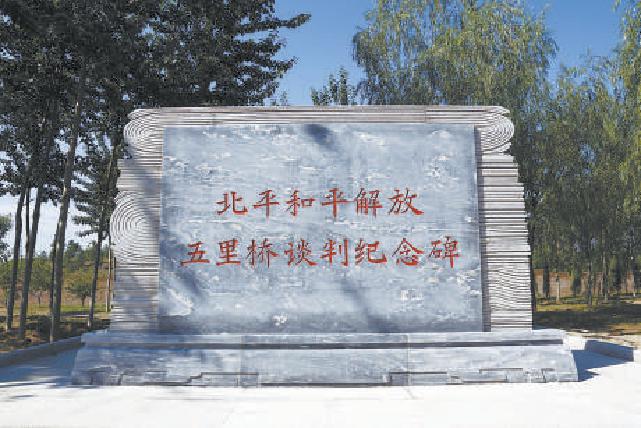
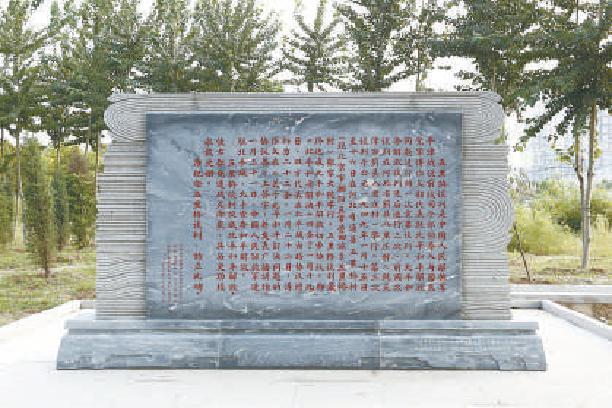
The negotiation monument of Wuliqiao in Beiping for peaceful liberation (Photo courtesy of Party History Office of Chaoyang District Committee)
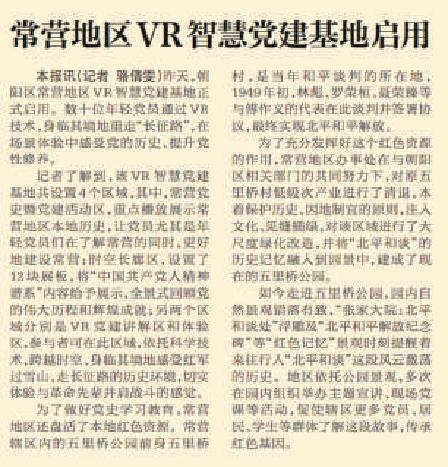
On June 30, 2021, the 13th edition of Beijing Daily reported that in Wuliqiao Park in Chaoyang District, the "red memory" landscape such as the Wuliqiao negotiation monument for the peaceful liberation of Beiping told people the turbulent history of the "Beiping Peace Talks".
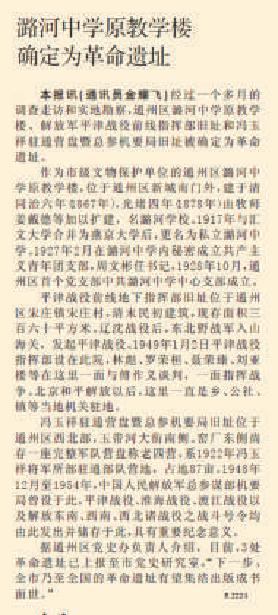
On August 19th, 2010, the 8th edition of Beijing Daily reported that the former site of the frontline headquarters of the People’s Liberation Army’s Pingjin Campaign was identified as a revolutionary site.
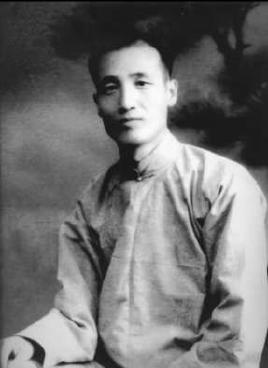
Yan Youwen
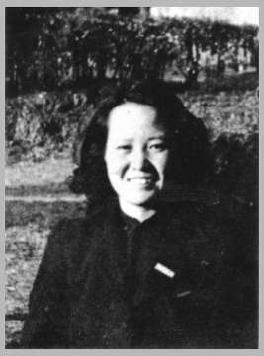
Fu Dongju
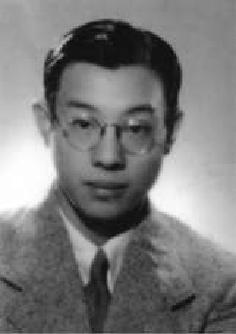
Li Bingquan (provided by Liu Kexing)
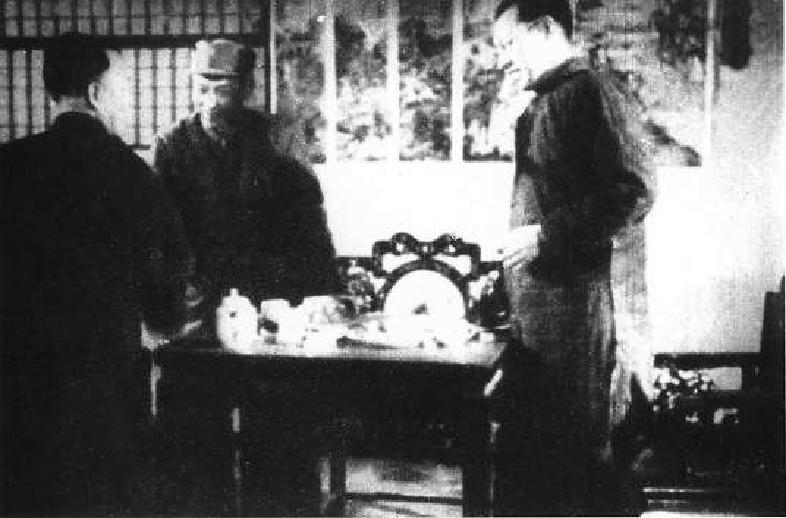
In the first peace talks, Su Jing, the representative of the People’s Liberation Army (second from left), Cui Zaizhi, the representative of the Kuomintang North China "suppression general" (first from left) and Li Bingquan, the representative of the underground party of the Chinese Communist Party (third from left).
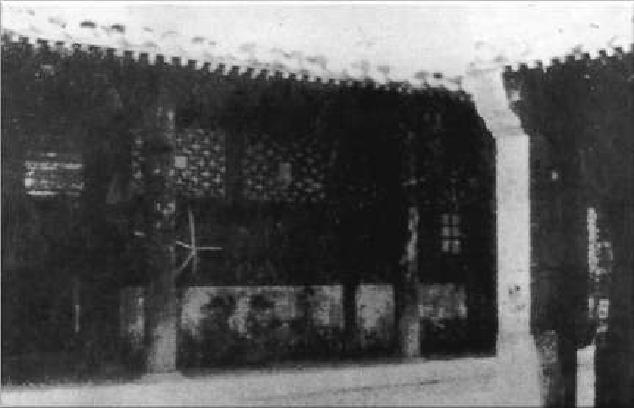
Wuliqiao peace talks former site
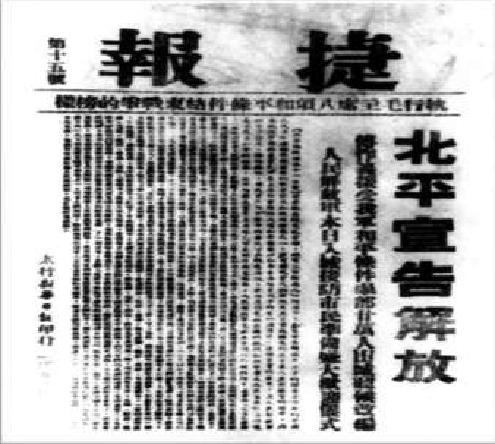
On January 31, 1949, Xinhua Daily, Taihang, published a good news that Beiping declared peaceful liberation.
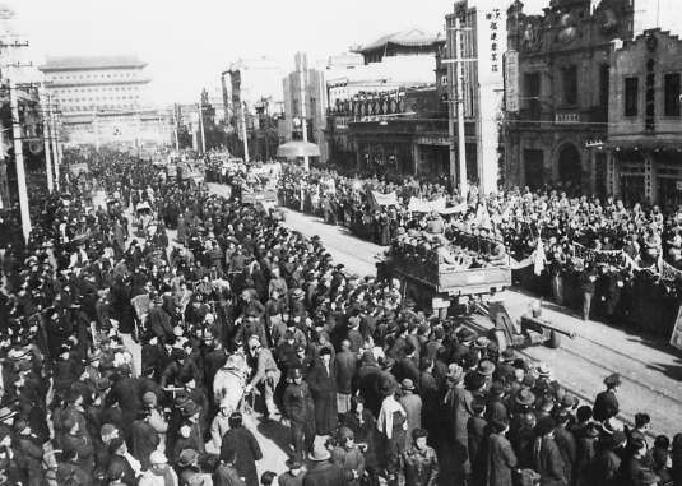
On January 31, 1949, Beiping was peacefully liberated. On February 3, the general public warmly welcomed the People’s Liberation Army into the city.