Revealing the cult that detonated the Korean epidemic: once participated in the presidential campaign, attempting to infiltrate China and being expelled.
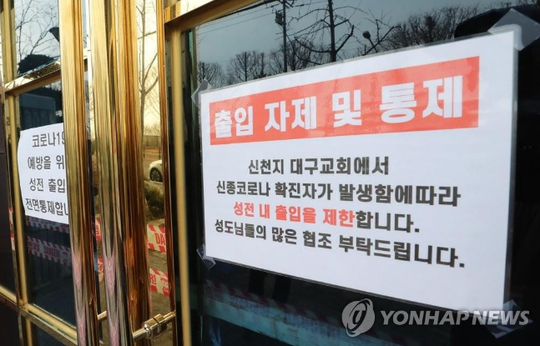
Daegu Church in Xintiandi is closed, according to Yonhap News Agency.
Cover journalist Yan Lei
As of 9: 00 a.m. on February 24th, there were 161 new confirmed cases of novel coronavirus infection compared with 4: 00 p.m. the previous day, with a total of 763 cases and 7 deaths. Among them, the number of confirmed cases related to the cult organization Xintiandi Church increased to 458, accounting for 60% of the total confirmed cases.
With the increasing number of confirmed infections, the "Xintiandi Church" has attracted the attention of the outside world. What kind of cult organization is this?
The founder is deified and has multiple peripheral organizations.
Xintiandi Church, whose full name is Xintiandi Jesuit Evidence Tent Temple, was founded by Korean Lee Wan-hee on March 14th, 1984, and its headquarters is located in Guochuan City, Gyeonggi Province, South Korea. Born in Gyeongsangbuk-do, South Korea on September 15th, 1931, Lee Wan-hee was deified as "Holy Spirit Protector", "Second Coming to Christ" and "God-appointed priest".
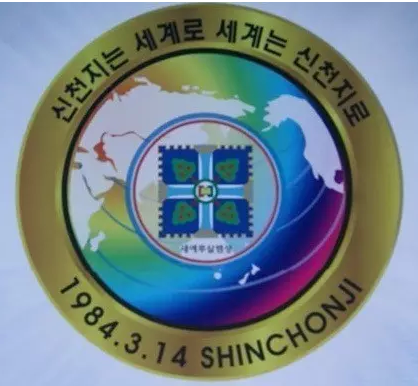
Logo of "Xintiandi Church"
According to the China Anti-Cult Network in November 2018, in Li Wanxi’s autobiography "The Road I Walked and the Grace of God", he said, "I am a descendant of the royal family and came to this world as a light." "On one day, I met Jesus, the heaven and man who fell from the sky." Everywhere I go, there are rainbows, crosses (clouds) and light.
Xintiandi has a number of peripheral organizations, such as International Youth Peace Organization, Peace Restoration Organization of Heaven Cultural World, World Women Peace Organization, Mana Youth International Alliance and Mana Volunteers Association. Among them, the director of the World Women’s Peace Group is Kim Nam-hee, the backbone of the organization.
Xintiandi Church claims that Li Wanxi is the "savior" and denies the universality of Jesus Christ’s salvation, which is spread all over 75 countries around the world. It is reported that by the end of 2018, the number of people enrolled in Xintiandi in South Korea was 170,000, and the number of people in training was about 200,000.
In addition, Xintiandi Church will lynch all kinds of people it regards as dissidents by means of terrorism, and afterwards it will create the illusion that "the deceased died in an accident instead of homicide" to cover up the crime.
The internal hierarchy is strict, and it has been recognized as a cult by the Korean church.
The "Xintiandi Church" has a strict hierarchy and was recognized as a cult by the Korean Christian Federation in 2016. The reporter looked up the information and found that the missionary methods of Xintiandi Church were similar to those of many cult organizations.
The senior backbone of Xintiandi lures believers and the masses into the brainwashing class to become "students", and controls the students’ thoughts through intensive and crazy so-called "teaching brainwashing", and then controls their spirit and behavior, so that the students can do whatever the lecturers, administrators and superior backbone of the brainwashing class say.
Under the hierarchical system in Xintiandi, it is basically normal for senior male cadres to rape, molest and play with young female believers by taking advantage of their powers. The upper level acquiesces in these criminal acts and shelters the rapists.

Li Wanxi, the leader of the cult organization, is in a wheelchair.
In 2013, Li Wanxi was retaliated for sexually assaulting an underage girl, and was hospitalized after her leg was broken. On October 30-31, 2014, the 31st General Assembly of Korea Christian Supervisory Council recognized Xintiandi Church as a cult under the guise of Christianity.
In March, 2015, Korean Christian radio station CBS broadcasted eight episodes of the documentary "The Man Who Fell into Xintiandi", denouncing Xintiandi for spreading cults and endangering society. After the film was broadcast, it quickly topped the search list of Naver and Daum, the two largest portals in Korea, and was widely reported by the media.
On April 19, 2016, the Korean Christian Federation issued an announcement asking Korean church believers to be alert to the erosion of the "Xintiandi Church". According to the Federation, Xintiandi Church has been recognized as a cult by the Korean Church.
Reaching into politics, he once participated in the presidential campaign.
According to South Korea’s CBS, Lee Wan-hee ordered tens of thousands of his followers to join the New National Party during the presidential campaign in South Korea in 2007, promoting the momentum for Lee Myung-bak, then the presidential candidate, and his New National Party.
According to the report, during the presidential campaign in 2007, "Xintiandi Church" sent "Xintiandi Foreign Activities Assistance Guide" to 12 Korean tribal organizations, instructing them to organize and mobilize 10,670 Xintiandi Christians to join the New National Party as special party member.
Moreover, during the presidential campaign in 2012, Korean media confirmed through various surveys that Huang, the "Chief Elder of Xintiandi", had served as a standing consultant in the New National Party and also served as the chairman of the administrative autonomous organization in the park geun-hye campaign team.
At that time, many religious experts pointed out that "Xintiandi extended its tentacles to politics, with the aim of further expanding the size of the church and whitewashing its cult identity after gaining political support."
Yonhap News Agency reported on the 22nd that in 2018, "Xintiandi Church" also tried to send its followers into Wuhan to preach, and planned to open an office there, but it was quickly discovered by Wuhan police and deported.
However, according to the Global Times, there are many religious groups in Korea, and some religious groups have considerable influence. The Korean authorities have basically left religious groups alone, and some politicians have been too close to religious groups for elections.
Although the "Xintiandi Church" has long been recognized as a cult, South Korea lacks the legal basis to crack down on them, and Korean law enforcement agencies are also in an embarrassing situation.
Tried to infiltrate into China and was banned by the relevant departments.
According to the disclosure of China Anti-cult Network, Xintiandi Church once infiltrated into China under the banner of Christianity and non-profit organizations, but it has already been banned by many government departments. The Ministry of Public Security of China has also named people in Guanwei to remind people not to believe the lies of Xintiandi.
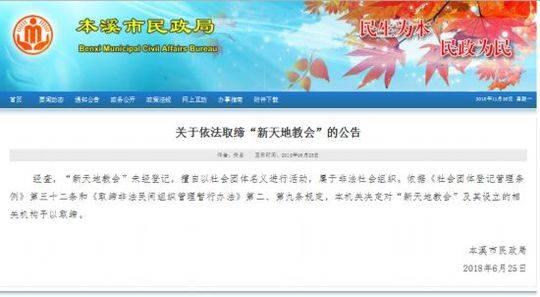
Notice of Benxi Civil Affairs Bureau of Liaoning Province
On June 25, 2018, the Civil Affairs Bureau of Benxi City, Liaoning Province issued the "Announcement on Banning Xintiandi Church according to Law", saying that after investigation, "Xintiandi Church" carried out activities in the name of social organizations without registration, which was an illegal social organization. According to Article 32 of the Regulations on the Administration of Registration of Social Organizations and Articles 2 and 9 of the Interim Measures for the Administration of Banning Illegal Non-governmental Organizations, this organ decided to ban Xintiandi Church and its related institutions.
Previously, Xiangfang District Civil Affairs Bureau of Harbin, Heilongjiang Province, Suihua Civil Affairs Bureau and Fengtai District Ethnic and Religious Affairs Office of Beijing also issued similar announcements.
Xintiandi often holds so-called public welfare activities under the pretext of "help", "love" and "peace" in the name of so-called public welfare organizations, and takes advantage of such public welfare activities to carry out illegal missionary work. In December 2015, Xintiandi established the so-called "Lighting the Peaceful Sky" charity organization in Taiyuan and launched the "Morning Star Volunteer Charity Association" in Shanghai.
It is reported that Xintiandi seduces young people in Beijing under the guise of outdoor photography, learning Korean, learning the Bible for free and making friends in the same city. Once you are hooked, you will be brainwashed through progressive training, such as "Gospel Room" and "Seminary". For those who have successfully brainwashed, "Xintiandi" requires the submission of personal and family information such as ID cards and household registration books, and formally develops into teaching.
In order to escape the blow, in the "gospel room" stage, they often "train" newcomers in one-on-one way in fast food restaurants such as KFC and McDonald’s near subway stations.
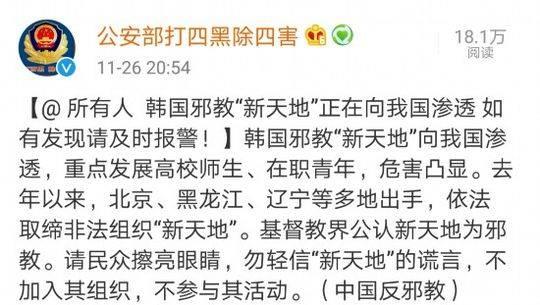
At the end of November 2018, China Anti-cult Network, "The Ministry of Public Security cracked down on four evils" and "Global Anti-evil Alliance" jointly issued warnings to remind people not to believe in the lies of Xintiandi, not to join its organizations and not to participate in its activities.
(Part of the information is based on China Anti-cult Network and Global Times)
Reporting/feedback