"Reduce allocation", retreat and retreat
Author | Wang Pan
Edit | Lengzelin
In 2016, the domestic MPV market sales reached 2.497 million units. At that time, it was thought that the MPV market was about to reach another peak. But in the following year, the rise for eight consecutive years came to an abrupt end, followed by a decline for five consecutive years.
In 2021, the cumulative sales volume of MPV market was 1.079 million vehicles, down 1% year-on-year, and it was also the only market in the three major market segments that declined year-on-year. At the beginning of this year, affected by various factors, the whole domestic auto market was shaken. The only surprise was that the sales volume of MPV1-May still ranked last with a growth rate of -25.5%.
Strangely, however, no matter how depressed the MPV market is, major car companies are actively releasing new MPV cars this year. The models with independent brands have appeared, such as Tengshi D9 and Lantu Dreamer, and the brands such as Hongqi, Weipai and Weilai are also accelerating their entry. The joint venture models include Toyota Saina and its sister model Grevia, which have attracted a lot of attention in the market.
In particular, when Saina was introduced into China at the end of last year, it was once exposed that "the price can only be raised by 60,000 yuan".
In fact, the decline in the overall sales volume of MPV market is one aspect, while the constant adjustment of the market sales structure is the other. Among them, the proportion of functional MPVs is shrinking, and the proportion of commercial and household MPVs is expanding.
Take Wuling Hongguang and Buick GL8 as examples. In the first quarter of 2017, their sales volume was about 150,000 and 30,000 respectively. In the first quarter of this year, their sales volume was about 57,000 and 32,000 respectively.
Starting from this year, the layout of major car companies is also aimed at the home MPV market with greater potential.
However, drivers will pay attention to the ability to control the vehicle, that is, whether they are confident to drive the vehicle to complete overtaking and braking at a certain distance, and the long-term downturn of MPV has also caused many household groups to be unfamiliar with this type of vehicle.
At the same time, because the objective conditions such as MPV body size and center of gravity are different from those of cars and SUVs, it is actually a dangerous behavior to bring past driving experience into MPV.
According to a report of iResearch, safety ranks first in the ranking of "factors of concern" and "core appeal" in purchasing MPV, and braking performance ranks first in the ranking of "safety of concern", but do most people really know the performance of MPV like the back of their hands?
There is a big difference in braking performance between high and low match Senna.
Recently, I know that Che Di did a brake test on the popular MPV, and the most popular Saina gave the most "unexpected" results during the test.
This test used Toyota Saina 2021 2.5L Hybrid Deluxe Edition (the second lowest match), and the best result of 100-kilometer braking was 38 meters in dry land and 38.9 meters in full load, which was in the middle and upper reaches. However, on the ABS pavement in the wetland, its no-load data soared to 277.4 meters, and the full load exceeded 300 meters (the longest in the wetland test area was 300 meters). After rushing out of the test area, the speed of the car was still as high as 50 km/h.
Because of the different friction coefficients between wet and dry roads, the latter itself will multiply the braking distance of the vehicle. If you just watch the race, the performance difference between wet and dry roads may be understandable.
But interestingly, there is also a big difference between the high and low versions of Toyota Saina in the braking performance of 100 kilometers, in which the braking performance on dry ground is at most 1.1 meters regardless of no load and full load, while in the wetland, the braking distance of the high version is more than 50 meters shorter than that of the low version at most.
Imagine that the extra braking distance of 50 meters is enough to determine the direction of many accidents, especially when the MPV market is gradually changing from functional and commercial to family-oriented. Such safety performance is really not enough to convince most users who buy for family behavior purposes.
So is this the case for all MPV models? The program group also found GM Buick GL8 2022 ES Luzun 653T exclusive model (second-lowest), Kia Jiahua 2021 2.0T flagship model and Honda Odyssey 2022 2.0L sharp and glorious version for testing.
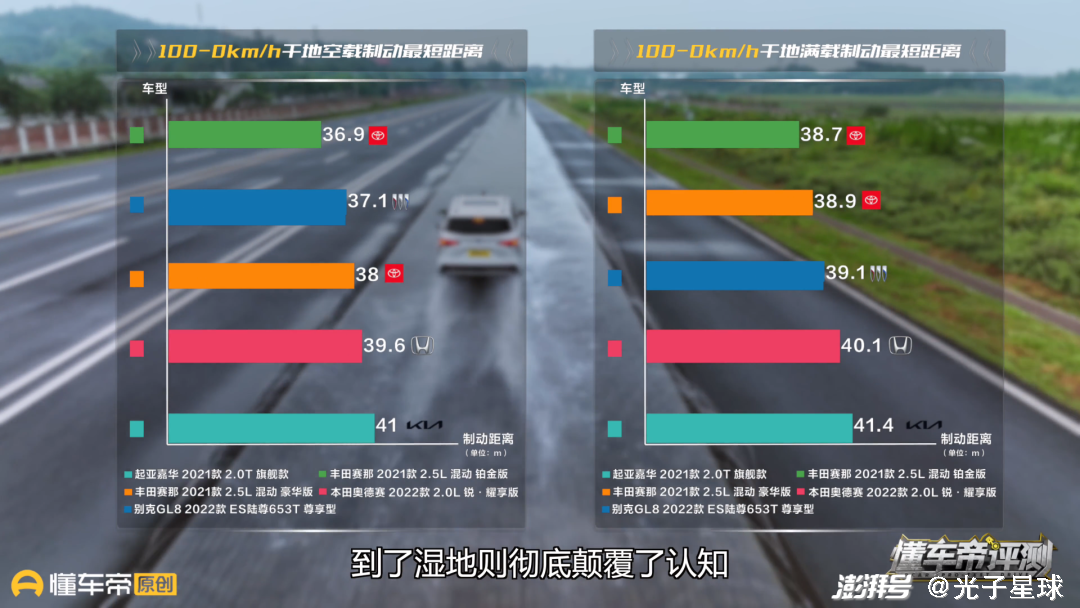
In the test results, in the dry land no-load and full-load scenes, the Saina has achieved good results regardless of the high and low match, but once in the wetland, the low match version has become the bottom, while the high match version is still among the best in several models.
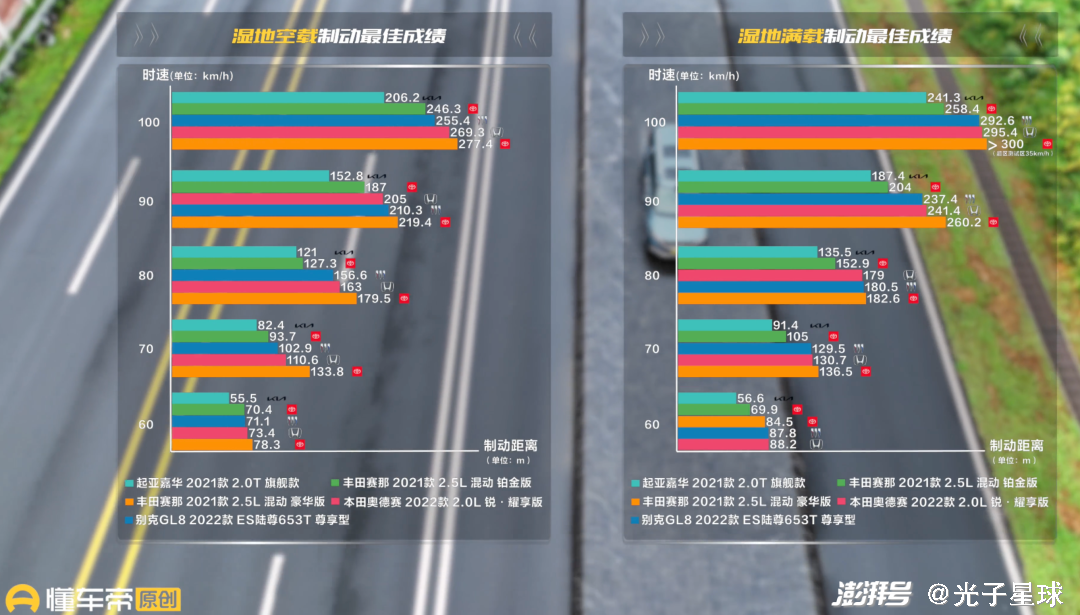
What’s the problem with poor braking in low match? The answer given by the program group is tires.
Among the several models tested this time, only Saina and Odyssey are equipped with different grades of tires according to different versions, among which the low version of Saina adopts Tongyiou 104S-class tires and the high version adopts Goodyear 103V-class tires; Odyssey uses V-class and H-class tires respectively; GL8 Lu Zun is equipped with 99V class tires, while Jiahua is equipped with 103H class tires.
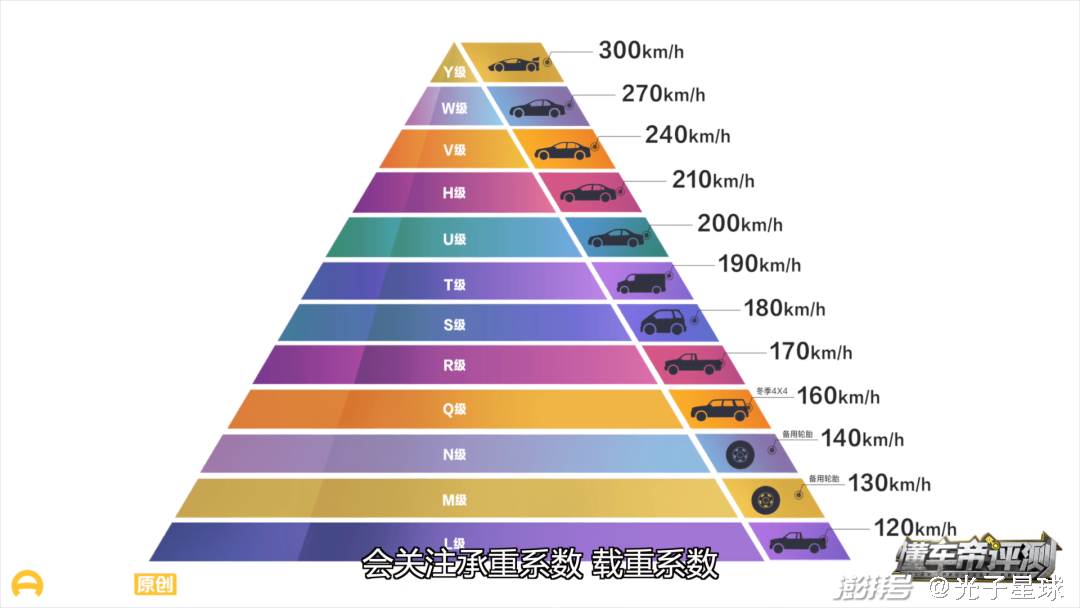
Tire grades will be divided into multiple grades according to different vehicle speeds. Among them, the S-class tire used in the low-level race is worse than other models by more than one grade, and its top speed is 180 km/h. It seems that the numerical value alone is not bad, but at present, only Hongguang MINI EV is used in the same model with S-class tires.
The overseas version of Saina comes standard with T-class tires, which is also one level higher than the domestic low-grade version.
This can’t help but raise questions. Is Toyota Saina deliberately "reducing distribution"? This is not because consumers are suspicious, but because joint venture vehicles have long been the "hardest hit" for reducing allocation.
In recent years, the operation of reducing the allocation of joint venture vehicles before introducing them into China has almost become commonplace, which has led to three factors. For example, due to different domestic and foreign laws and regulations, some models of Toyota Corolla and Lei Ling have cancelled the ESP body stability system aboveboard; Secondly, according to different market preferences, manufacturers will also adjust the configuration. For example, the American version of Audi A6L is better in powertrain and handling than the domestic version, but the domestic version of A6L is cheaper and has a longer wheelbase.
The third point can also be derived from the second point. The persistence of some domestic consumers in space and size, as well as the blind obedience of joint venture brands, have also led many manufacturers to always "touch" the imported domestic models. The patience of consumers seems to be only the push of joint venture brands.
Trying new things should not be a "victim"
However, consumers who are "rationed" should also be treated rationally. Take the 75kWh ternary lithium iron battery pack launched by Weilai last year as an example. Although some ternary lithium batteries in the battery pack were replaced with cheaper lithium iron phosphate batteries, the energy density and endurance were improved, and the experience of consumers did not decline. At the same time, enterprises also reduced costs and contributed to positive development.
Therefore, there are several key prerequisites for defining "reduction": whether consumers know; Whether to treat people in different markets differently; And whether it reduces the experience at the same price.
Toyota Sienna was born in North China in 1997. Since the second generation, it has entered the market in parallel, and it was officially listed in China last October.
Compared with the previous parallel imported version, the domestic Saina has been castrated once. For example, the all-round four-wheel drive has been changed to the front-drive, but the same starting price has also been relatively reduced by about 100,000 yuan, which can be understood as the strategic adjustment made by the manufacturer for domestic market competition.
However, the tire problem in this low-level match is hard to be understood as the strategic adjustment of the manufacturer.
Besides being different from the foreign version, this tire can’t be purchased in the market, and the lowest grade tire that TOYO can buy in the market at present is also H grade.
Obviously, the test mentioned above has proved that the tire grade has a great influence on the braking performance, and the operation of reducing the cost safely can’t help but remind people of Jetta with a hanging board or Passat with a broken A-pillar.
It seems that these "common tricks" have been well known to consumers, and joint venture vehicles have to open up new methods of "reducing costs".
Because the automobile industry started in China for a short time, most people still rely on the paper data of "three big parts" (engine, gearbox and chassis for fuel vehicles, motor, electronic control and battery for electric vehicles), and often ignore the consideration of more components that affect safety performance.
In a healthy market, there must be the first batch of people who are willing to try unfamiliar new things, such as the wave of electrification and intelligence, and MPV, which is still unfamiliar to many car owners at present.
However, we should not take life as a "bet" when trying new things, especially cars, which are products bearing family safety. The assisted driving system previously promoted by major car companies with "automatic driving" has also paid the price of blood.
If car companies still can’t "wake up", in addition to the need for independent brands to produce competitive products, more professionals are needed to raise awareness for consumers, thus achieving "reverse".
Old and new changes in the automobile market
Looking back at the new MPV mentioned above, it is not difficult to find that independent brands occupy the majority, and almost all of them are mainly mid-to high-end models.
In fact, not only the MPV, SUV and car market are also being recovered by the rising domestic brands. If the market monopolized by joint venture cars is the seller’s market, then with the enhancement of the competitiveness of independent models, cars are moving towards the buyer’s market.
Consumers’ choices are not limited to joint ventures and imports. Hybrid systems such as BYD DM-i, Chery Kunpeng, Great Wall Lemon and Geely Raytheon have broken the rule of "two fields", and the new forces headed by Wei Xiaoli have broken through the high-end blockade of BBA in terms of intelligence.
At the same time, in addition to the single collision test of China Insurance Research Institute and other institutions as a reference, the prosperity of video and graphic media has also made more comprehensive tests and information jump in front of consumers.
Rational consumers are less and less willing to pay for dishonest joint venture brands. As a result, Porsche’s reduction of electric steering column will be condemned by the whole people, and finally Porsche China has to apologize and issue a compensation statement under the pressure of public opinion.
I have to admit that Toyota Saina is an excellent product. Although it has experienced a "price increase" storm after listing, its sales trend is still rising this year. According to the data of new car compulsory insurance, Saina has surpassed Buick GL8, which has dominated the high-end MPV market for a long time, with 7043 vehicles in May.
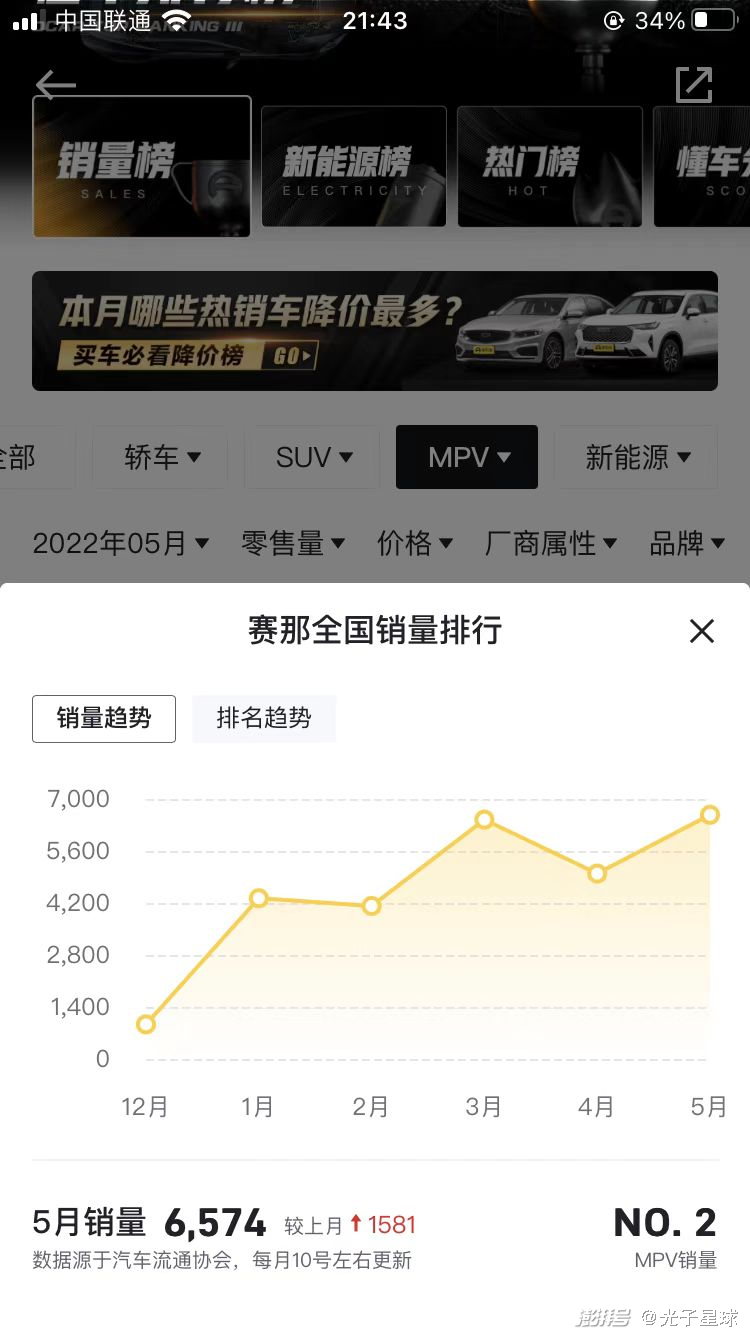
However, it is a pity that this product does not pay attention to tire safety and the different treatment in domestic and foreign markets will inevitably make consumers who hold money for purchase give in by three points. At the moment when domestic manufacturers have come up with high-end MPV products one after another, the crown of Saina is not necessarily so stable.
Euler Good Cat achieved a good monthly sales of tens of thousands of vehicles in December last year, ranking seventh in the total list of new energy sources in that month. However, due to the difference between the overseas version and the domestic version of the chip, consumers voted with their feet, and its sales volume also began to plummet. According to the data of Automobile Dealers Association, Good Cat sold 3,517 vehicles in May, about one-third of the peak period.
At present, China auto market is a complex market, which is full of uncertainty due to the power replacement of motors and engines, the reconstruction of the relationship between OEMs and consumers, and the competition between independent and joint-venture brands. Enterprises and consumers are also in the process of transformation and separation of old and new thinking.
But one thing can be confirmed, that is, today’s China auto market is moving towards a more mature, transparent and standardized market.